
Business data never sits still. Systems get updated, definitions evolve, and data models shift constantly. But when we build AI data assistants, we often forget this basic fact. We feed the AI a perfect snapshot of how the business works today, completely ignoring that the business will look different tomorrow. This creates a hidden problem that quietly destroys trust over time: stale context.
Think about a classic scenario. As an experienced analyst I know exactly what to do when a core metric suddenly drops on a Tuesday morning. You do not just accept the number. You go into investigation mode.
You start checking what changed. Did a data pipeline break? Did the product team release a new feature that altered user behavior? Did someone silently update the calculation in the ETL or the BI dashboard? As a human you recognize you have an information gap. You track down the change because you know there's something you don't know.
Now look at how an AI data agent handles that exact same scenario. The agent does not know that the product team launched a new feature yesterday. It does not know the data engineering team changed the ETL logic over the weekend. Unless someone explicitly updates its instructions, it will keep using the context it was already fed. It will look at the dropped metric and confidently tell your stakeholders that business performance is down, completely missing the actual story.
The Illusion of Static Knowledge

When we build AI applications, we often treat business knowledge as a static asset. We export data dictionaries, write long system prompts, and upload files.
But a business is a living organism. Changes happen every day:
- Metric Drift: Marketing decides to change the definition of a "Qualified Lead" to include a new country.
- Schema Evolution: Engineering restructures the database, splitting a massive transactions table into subscriptions and one-time sales.
- Tribal Knowledge Updates: Someone finds a bug in how timezones are recorded. The analytics team informally agrees in a Slack channel to always convert dates to UTC before filtering. This rule never makes it to the official documentation.
If your AI does not know about these updates, it starts operating in an alternate reality. When an LLM works with stale context, it does not throw an error. It confidently gives you the wrong answer.
The Maintenance Nightmare
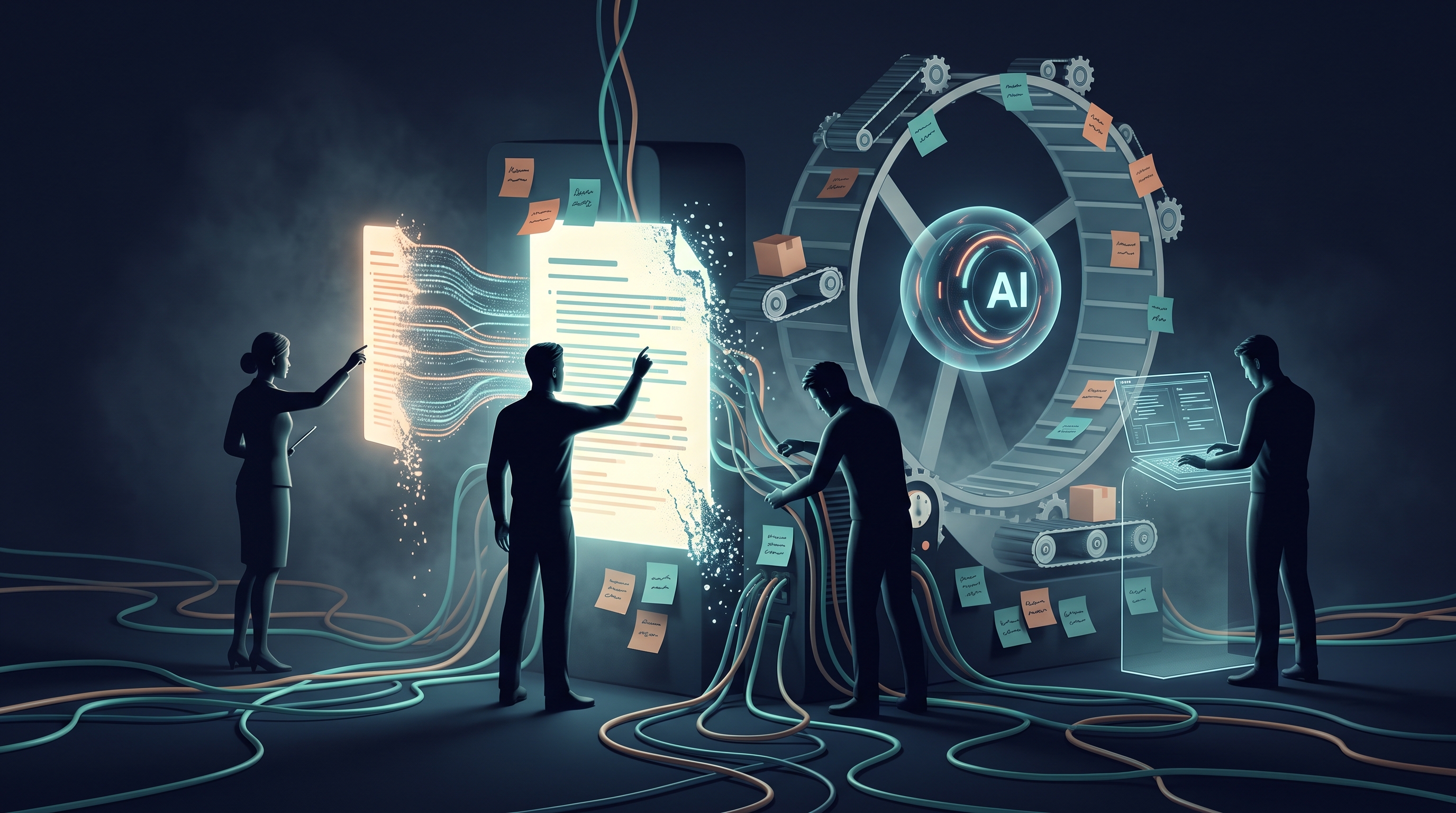
This creates a massive problem for an organization. Business users do not care why the AI got the revenue number wrong. They just know they can no longer trust it. Once people lose trust in an AI tool, they stop using it entirely.
To prevent these silent failures, data teams get stuck in an endless cycle of manual updates. When a product manager launches a new pricing tier, or finance changes how they calculate fiscal quarters, the AI must be updated. Someone has to remember to manually rewrite the prompts or update the agent instructions.
This becomes a major bottleneck. It requires constant coordination between business operators, data teams, and AI engineers just to keep the AI from breaking. Treat that as a project and you have invented a second platform whose only job is to describe the first one.
From Static Documents to Living Systems

You cannot solve dynamic business problems with static context. Relying on hardcoded prompts is like handing a new analyst a company handbook from 2019 and expecting them to know how things work today.
To build reliable AI, organizations need an intelligent intermediate layer that sits between the data sources and the AI. That is a context layer: it needs to actively monitor and sync with the current state of the business.
When a metric changes in your semantic layer, the AI should know instantly. When data models are updated, the AI's map of the data should update automatically. When team members discuss a new edge case in Slack, that knowledge should be captured for the AI to use on its very next query.
The True Measure of AI Readiness
Building an AI tool that works on day one is great. But the real test of a mature AI architecture is how it performs months later. Business context is fluid. By building systems designed to maintain a live and up to date understanding of your operations - the job modus exists to do - you ensure that your AI scales securely and accurately alongside your business.
This is what modus builds.
A context warehouse for data agents - automatically mined, intent-composed, securely delivered.