
Somewhere in the last six months, your CEO asked a question nobody could answer in under three days. Why net retention slipped in EMEA. Which accounts are actually at risk. What "qualified pipeline" means now that Sales quietly rewrote the stage definitions in March.
And you said: what we need is a company brain.
You were right about the problem. The trouble starts with everything that comes after that sentence.
What usually follows is a project. A dedicated squad. A vector store, a knowledge graph, a hand-curated corpus of dashboards, docs, dbt models and Slack threads, wired into an internal chat surface with your logo on it. Six weeks to a demo the exec team loves. Then eighteen months of your life.
You're not solving a problem. You're taking on a dependency.
Here's the thing about a system your CEO uses personally: it never gets deprioritized, and it never gets to be wrong.
An internal tool that fails quietly earns a Jira ticket. An internal tool the CEO quotes in a board meeting earns you a calendar invite. The moment the brain becomes load-bearing for executive decisions, its freshness, accuracy and uptime turn into a permanent standing obligation for your team - not a project with an end date, but an on-call rotation for the truth.
That's the actual trade. Not "six weeks of build." A dependency with no expiry date, owned by the person who sets your roadmap.
And it won't stabilize. Not because your team isn't good, but for four structural reasons.
1. Context goes stale faster than you can ship
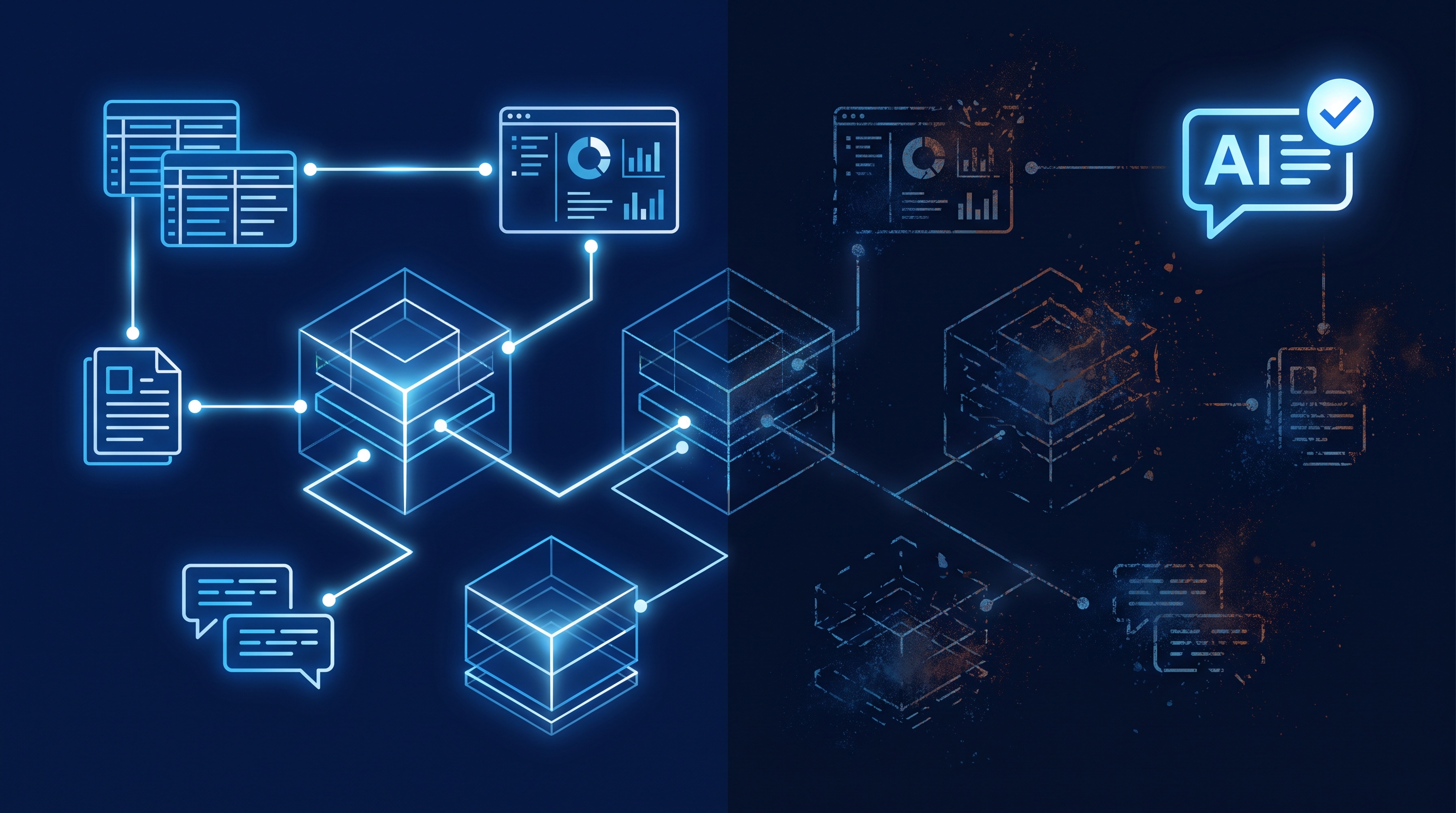
The data in your warehouse is versioned, tested and monitored. The context around it isn't. Nobody owns the fact that revenue_final_v2 was superseded in Q3, that the churn definition changed when Finance moved to a new billing system, or that the dashboard your brain treats as authoritative was abandoned by its team nine months ago and is now maintained by nobody.
That layer decays continuously and silently. Schema changes, metric redefinitions, reorgs, deprecated pipelines, a Notion page someone edited on a Friday. None of it fires an alert. Your embeddings don't know they've gone wrong - they just keep answering, confidently, from a map of a company that no longer exists. Stale context does not throw an error. It quietly destroys trust.
So you build a refresh process. Then a review process. Then a "context steward" rotation nobody wants. You have now invented a second full-time data platform whose only job is to describe the first one.
2. Answers that are 75% right are worse than answers that are obviously wrong

This is the part most teams underestimate, and there's now hard evidence for it.
On Spider 1.0 - the academic text-to-SQL benchmark - frontier models look excellent, clearing 85–91%. On Spider 2.0, which uses real enterprise databases with over a thousand columns, multiple SQL dialects and actual project codebases, the same models collapse: o1-preview solved 21.3% of tasks, GPT-4o around 10%. Same models. Same task category. The difference is your schema.
Now compound it. A real question - "why did EMEA retention drop" - isn't one step. It's a chain: pick the right tables, apply the right filters, use the right metric definition, join correctly, interpret the result. At 95% per step, ten steps gets you to roughly 60% end-to-end. Twenty steps, 36%. The research on long-horizon LLM tasks makes the same point from the other direction: a 1% per-step error rate is expected to derail a task within about a hundred steps.
But the operational damage isn't the failure rate. It's that a 75%-accurate brain is right often enough to be trusted. Wrong answers don't announce themselves. They get pasted into a board deck. They become the basis for a headcount decision, a pricing change, a territory reshuffle. By the time someone catches it, three downstream decisions have already been made on top of it. Gartner puts the cost of poor data quality at $12.9M per organization per year - and that's before you've built a system that launders bad context into executive confidence.
3. You will spend the next two years feeding it
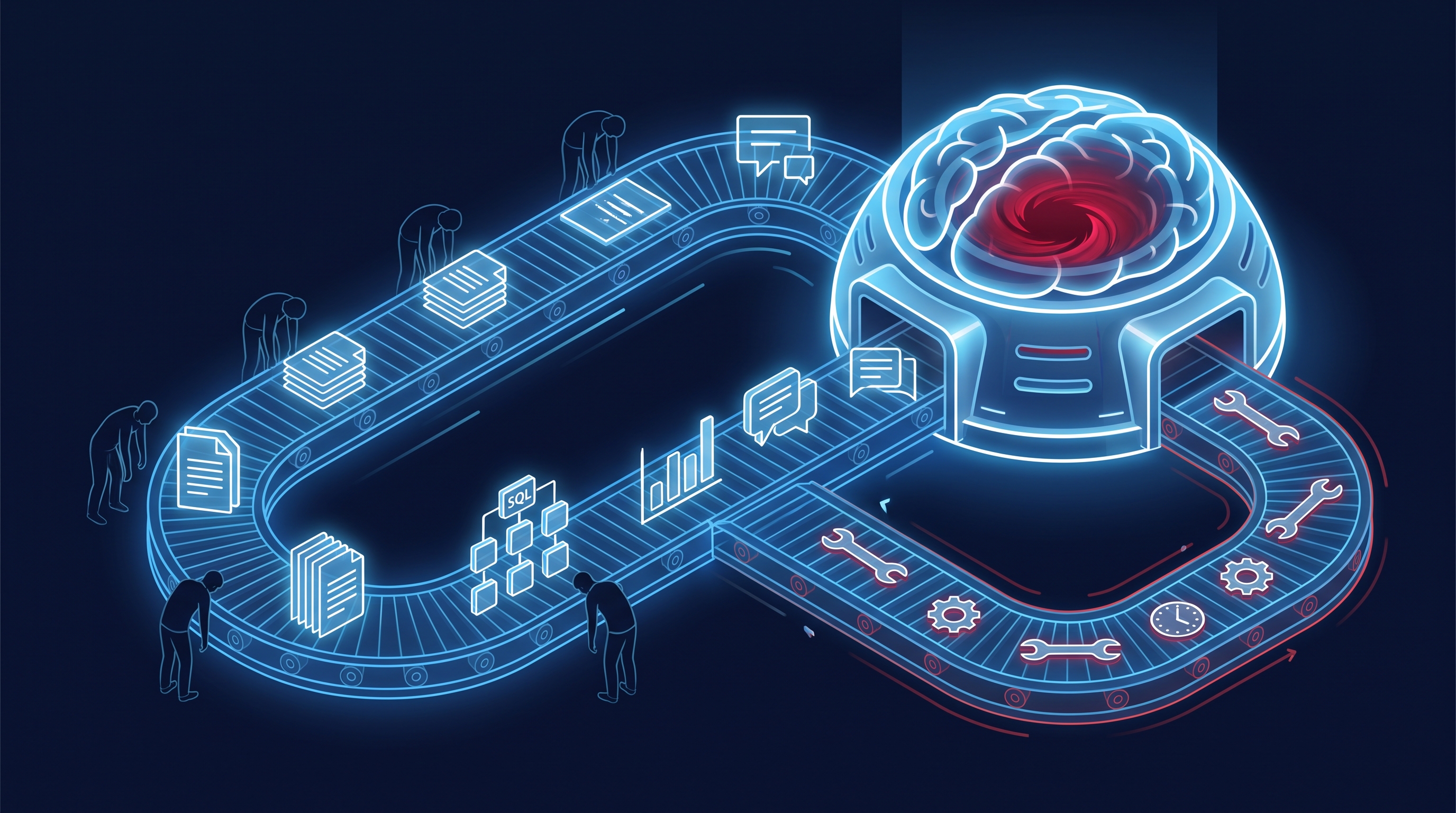
Your data engineers are already underwater. Fivetran's research with Wakefield found engineers spend close to half their time just maintaining existing pipelines, at an average cost of $520,000 a year per organization - and that 69% of data and analytics leaders believe business outcomes would improve if that time went elsewhere. Monte Carlo's survey put 40% of data professionals' time into evaluating and checking data quality, with the average org fielding around 61 data incidents a month.
The company brain adds a new layer on top of all of that, with none of the tooling maturity. Run the arithmetic on a 20-person data org: half of capacity is 120 engineer-months a year. That is your AI roadmap, spent on keeping an internal chatbot current.
dbt Labs' 2026 State of Analytics Engineering report caught the same imbalance in the wild. Trust in data jumped from 66% to 83% as a stated priority in a single year. But while 72% of teams prioritize AI-assisted coding, only 24% prioritize AI-assisted pipeline management - testing, observability, the unglamorous work that keeps any of this true. Everyone is accelerating output. Almost nobody is scaling the thing that makes output trustworthy.
4. The cross-org rollout is a permissions project wearing an AI costume
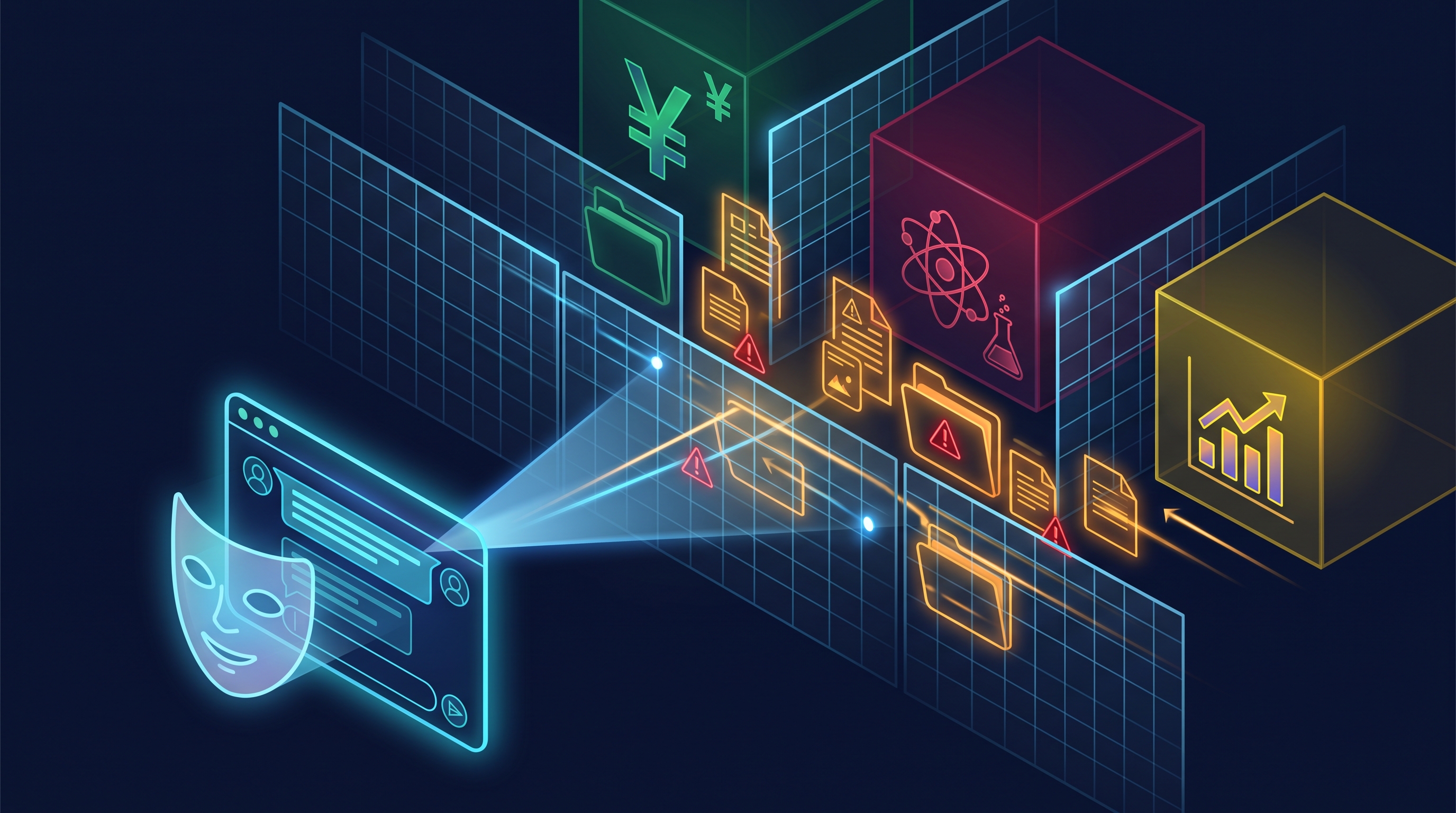
The demo works because it's you and the CEO and one warehouse. Then Finance wants it. Then R&D. Then Sales.
And now every answer has to respect who's allowed to see what - across systems whose access models were designed independently, over a decade, by people who've left. AI doesn't create that problem; it makes a decade of latent permission drift instantly queryable in natural language.
Microsoft's customers ran this experiment for you. In a Gartner survey of 132 IT leaders, oversharing concerns pushed 40% of organizations to delay their Copilot rollout by three months or more, 64% said information governance and security consumed significant time and resources during deployment, and 57% restricted the rollout to low-risk users. Concentric AI's analysis of over 550 million records found roughly 802,000 files at risk per organization, with 16% of business-critical data overshared. That's the baseline state of a normal enterprise before anyone points an LLM at it.
You will discover this at the exact moment your project has executive visibility and no remaining budget.
The Trojan horse

Put the four together and the shape is clear. You set out to solve a knowledge problem. What you ship is a permanent operational commitment, with an accuracy ceiling set by your schema complexity, a maintenance cost that scales with your org, a security surface that grows with every team you add, and a reputational exposure that lands on the person your CEO trusts to be right.
Gartner expects over 40% of agentic AI projects to be canceled by the end of 2027, citing escalating costs, unclear value and inadequate risk controls - not model quality. Separately, it predicts 60% of organizations will fail to realize the value they expected from AI because governance and data frameworks are incohesive. Those aren't predictions about models getting worse. They're predictions about exactly this build.
Own the questions. Don't own the plumbing.

None of this means the company brain is the wrong ambition. It's the right one. Agents that understand how your business actually works - which metric is authoritative, which dashboard people trust, which pipeline is dead - are going to be table stakes.
The mistake is treating context as a content project your team curates by hand, rather than infrastructure that's mined continuously from how your organization already uses its data. Starving the model or stuffing everything into the prompt both fail for the same reason: you never assembled the right context at the right time.
Nobody builds their own warehouse anymore. In 2015 plenty of teams did, and every one of them eventually paid the same tax: a platform group that existed to keep the platform alive, funded out of the budget meant for the business. Context is on the same trajectory - and it decays faster than storage ever did, because it changes every time a human changes their mind.
So draw the line. Own the questions, the definitions, the decisions and the governance policy. Don't own the crawler, the freshness loop, the entitlement propagation, the retrieval tuning and the eval harness. That's a product, not a quarter. It's the layer modus ships so your team can keep its roadmap.
The teams that win the next two years won't be the ones who built the most impressive internal brain. They'll be the ones who still had their roadmap.
modus is the Context Warehouse for enterprise AI.
We continuously mine context from how your organization actually uses its data - queries, dashboards, pipelines, code, semantic models - and serve it to your agents through MCP, with governance and entitlements intact. Most teams are live on top of their warehouse in under a week.